Follow along with the video below to see how to install our site as a web app on your home screen.
Note: This feature may not be available in some browsers.
Hello Guest, we are proud to now have our Wiki online that is completely compiled and written by our members. Feel free to browse our Jeep-CJ Wiki or click on any orange keyword when looking at posts in the forum.
1979 CJ-7 with a fiberglass body and 1982 wide track axles, 258 I-6 with a 1995 4.0 head, HEI distributor, Motorcraft 2100 Carb, T-18 wide ratio tranny, Super Lift Springs and 33s, a 1997 BMW 328i, and a 2010 REDLINE CONQUEST TEAM Cyclocross Bike. :)
Can someone please tell me what the point of heating the intake manifold with coolant through the heater hoses is? I understand that the older cast iron intakes got heat from being bolted to the exhaust manifold, but why heat them at all? It seems to me that this would make vapor lock more likely on hot days. Is it some kind of emisions thing?
1979 CJ-7 with a fiberglass body and 1982 wide track axles, 258 I-6 with a 1995 4.0 head, HEI distributor, Motorcraft 2100 Carb, T-18 wide ratio tranny, Super Lift Springs and 33s, a 1997 BMW 328i, and a 2010 REDLINE CONQUEST TEAM Cyclocross Bike. :)
I just did a quick search and may have found my own answer. I take it that heat sink thing that bolts into the bottom of the intake under the carb is an electric heater to heat the fuel/air charge on its way to the engine when it's cold. And I also read that there's a heat switch on the manifold, so I take it that the switch shuts off the power to the electric heater once the engine warms up. That would all make sense. Has anyone run with and without this to see if it really makes much difference? I'm hooking up a manual choke, so I think I'll be fine without having all this extra (heater hoses and wires to the intake), but would like to get opinions on it.
the water hoses are still on mine, but the heater on the bottom hasn't been hooked up for two years. its cold natured but, most carbureted vehicles are. outside that it runs fine without it.
1979 CJ-7 with a fiberglass body and 1982 wide track axles, 258 I-6 with a 1995 4.0 head, HEI distributor, Motorcraft 2100 Carb, T-18 wide ratio tranny, Super Lift Springs and 33s, a 1997 BMW 328i, and a 2010 REDLINE CONQUEST TEAM Cyclocross Bike. :)
the water hoses are still on mine, but the heater on the bottom hasn't been hooked up for two years. its cold natured but, most carbureted vehicles are. outside that it runs fine without it.
Thanks for the info. I wonder if it's even neccessary to have the heater hose routed through the intake without using the electric heater? I like the nice simple look of just having the two hoses run from the front of the engine, down the passenger fender to the heater core. I'd rather not change that unless someone can give me a good reason why I should heat the manifold. I noticed that the clifford after market manifold is also water heated.
IMHO the AMC 258 i6 / 4.2l is incredably cold natured, any thing I could do to get it warm as fast as possible would be a priority with me. this includs the TAC and cook stove on the exhaust manifold. I noticed the difference when the 4.0 head required headers and the TAC went away.
Suit your self, I like to think that the engineer that designed it had to have a good reason to change from the solid cast iron manifold to the wet aluminum.
I've had ice accumulate in the carb before. My vehicle kept getting slower and slower until I had to pull off the road. Idling for a few minutes melted the ice and I was able to go on. It seems like it always happened when it was snowing out. One reason to heat the intake is to prevent this.
1979 CJ-7 with a fiberglass body and 1982 wide track axles, 258 I-6 with a 1995 4.0 head, HEI distributor, Motorcraft 2100 Carb, T-18 wide ratio tranny, Super Lift Springs and 33s, a 1997 BMW 328i, and a 2010 REDLINE CONQUEST TEAM Cyclocross Bike. :)
If you're talking about me, after this weekend, I'll be running a 1995 4.0 H.O. head with a 1995 tubular exhaust manifold, and an 80's aluminum intake manifold that has the water jacket. I'm retiring the original 79 head, 1 bbl Carter YF carb, and manifolds. That's why I asked the question.
If you're talking about me, after this weekend, I'll be running a 1995 4.0 H.O. head with a 1995 tubular exhaust manifold, and an 80's aluminum manifold that has the water jacket. I'm retiring the original 79 head, 1 bbl Carter YF carb, and manifolds. That's why I asked the question.
1979 CJ-7 with a fiberglass body and 1982 wide track axles, 258 I-6 with a 1995 4.0 head, HEI distributor, Motorcraft 2100 Carb, T-18 wide ratio tranny, Super Lift Springs and 33s, a 1997 BMW 328i, and a 2010 REDLINE CONQUEST TEAM Cyclocross Bike. :)
I wasn't the one trying to figure out what carb I wanted. I knew as soon as I decided to do this head upgrade that I would be running a Motorcraft 2150 of 2100. Tonight I just rebuilt an old school 2100 with 1.14 venturies. I have to wait a day or two for my new jets to arrive in the mail before I can screw down the air horn.
I agree about not running antifreeze through the manifold, im working on getting my 79 CJ7 running and plan on not running it through. The only drawbach i find is no good place for an after market temp gauge. That and the potential to warp the intake.
1978 CJ7
Silver paint with black hard top on 33" radials & eagle alumium rims. Good looking ride and have done lots of work to make it look and run great.
Stock equipment is 258 carb, power brakes, power steering, hard top & hard doors (per vehicle gross weight) tilt steering wheel, big brake package with large rotars & drums, T18 Trans with low 6.4 granny gear, Dana 20 transfer, Dana 30 front axle, Dana 44HD rear axle with 3.73 gears. True Trac ft & rear.
I was around jeeps in the 70's and drove a 1973 Jeep Truck. My family had 4 jeeps at the time. We also joined a jeep club back then too. So about 6 years ago looked for a Jeep CJ and found the vehicle above.
Can someone please tell me what the point of heating the intake manifold with coolant through the heater hoses is? I understand that the older cast iron intakes got heat from being bolted to the exhaust manifold, but why heat them at all? It seems to me that this would make vapor lock more likely on hot days. Is it some kind of emisions thing?
Its kinda a thermo dynamics type of issue and view. If you heat the intake to apporx 195F Thermostate, the fuel / volital gas will evaporate, flash off, and STAYS in atomization. With out heated intake the fuel would pluddle, thus hard starts and issues in general. The unheated jacket is cool to touch when the fuel first start to evaporated. Evaporation is a cooling process.
There are TWO heaters the WATER Jacket and the electric porcupine heater under the carb. Both are very important. There are also issues with the radiator hoses and that some of the molded jeep hoses are not avail any more. The entrance & exit intake manifold radiator hoses have a BIG ISSUE if the LOOPS are two high the air bubble will slow the water flow.
Poor heat for vehicle
Lower heat for the manifold if there are air pockets
Hot summer temps may not have enough cooling.... The intake and heater core and even the rubber hoses themselves are all heat disapation devices.
The Cast Iron Manifold are bolted together and that does Transmission heat. There is also a trap door for hot air directions in the exhaust manifold with a BiMetal spring that opens and closes the flapper with them of manifold.
So if you follow the sorry long story .... the coolant, engine temps, hoses,
water jackets, electric heater all work together... if they have faults or issues. Auto will not run well.
1979 CJ-7 with a fiberglass body and 1982 wide track axles, 258 I-6 with a 1995 4.0 head, HEI distributor, Motorcraft 2100 Carb, T-18 wide ratio tranny, Super Lift Springs and 33s, a 1997 BMW 328i, and a 2010 REDLINE CONQUEST TEAM Cyclocross Bike. :)
I agree about not running antifreeze through the manifold, im working on getting my 79 cj7 running and plan on not running it through. The only drawbach i find is no good place for an after market temp gauge. That and the potential to warp the intake.
I'm actually now planning to run the heater hose through the intake, and I might hook up the electric heater to a toggle switch for cold weather starts.
You have two places in the engine block behind/under the exhaust manifold that would work well for an aftermarket mechanical temp gauge. But that all depends on if you're still using them for their original purpose or not.
1978 CJ7
Silver paint with black hard top on 33" radials & eagle alumium rims. Good looking ride and have done lots of work to make it look and run great.
Stock equipment is 258 carb, power brakes, power steering, hard top & hard doors (per vehicle gross weight) tilt steering wheel, big brake package with large rotars & drums, T18 Trans with low 6.4 granny gear, Dana 20 transfer, Dana 30 front axle, Dana 44HD rear axle with 3.73 gears. True Trac ft & rear.
I was around jeeps in the 70's and drove a 1973 Jeep Truck. My family had 4 jeeps at the time. We also joined a jeep club back then too. So about 6 years ago looked for a Jeep CJ and found the vehicle above.
I'm actually now planning to run the heater hose through the intake, and I might hook up the electric heater to a toggle switch for cold weather starts.
You have two places in the engine block behind/under the exhaust manifold that would work well for an aftermarket mechanical temp gauge. But that all depends on if you're still using them for their original purpose or not.
This will help with the water path... I wrote this up about a year ago. This should be a tech article..... tis a big issue for our little 258s and 232s.
Here is a post from another forum a yr ago... I had the same issue so I dug in. Per Olrev….. gone now…. No longer avail (Previous pics) That's where I got the part numbers for the heater hoses. Unfortunately, the website he gives no longer carries the bypass hose for the 258. Everybody has the bypass for the V8...none for the I6.
I wonder why this particular hose (bypass) would be dropped from production from all the major hose companies? You'd think at least the big jeep aftermarket guys would find a source. I guess when they started getting scarce, we all started improvising (as in your pic), making them scarce-er.
Written By, MN CJ7 Fred
On post number one from the other forum for some more background...
I took home a Gates 18763 which goes on a Ford Escort and gave it a try. I did have to twist it to get the angles right and I cut off about an inch on the intake side, but it seems to fit nicely...3/4 and 5/8 ends.
What was wrong with this. Trim the thermostate end to lower it????... if I understand... and that is the end that is twisted a bit too. Thats the end with the coil corrector.
I do not remember what the Thermostate OD end is. I know the water pump to heater core is 7/8 and that is a issue. Was the 18763 correct for the thermo... I am talking to GATES right now. GATES Says #18763 it 5/8" and 27/32" ends and he said use the coil too. I asked him about heating in oven to plyable state to take the twist out... he did not like that idea.
I am looking at past notes. If you or anyone reading knows the thermostate output to manifold size in OD inches???? Looking for the 70s, 80, and even remember there is a thermstate cover swap that has a Temp Sensor hole... I am going electric fan with that cover... so that OD would be good too.
Gates does have some stuff and I am looking
Ok.... think I got done pretty well.
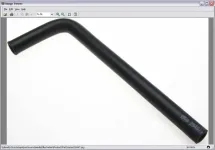
The right angle molded hose posted Keith460 Picture I copied over this this thread, #11. Will work but it a bit small in hole diameter. Here is the desc from Napa's site but no picture what on napa's site.
Napa #10909 Description Hose - Heater Attibute Product Features:Specially Designed, OEM Style Factory-Molded Hose To Fit Today's Smaller, Tighter-Fitting Engine Compartments. Can Be Used For Coolant, Water & Air Applications.,I.D.(s):.59"
At .59 is a bit small. 5/8" is what we have on Thermo and Manifold Pipe 5/8 = .625"
Called and spoke to GATES Applications today. We looked at a few years... the 1991 lead us to #28467, #18702, #18768 as hose products they have for 1991 YJ. The #28467 is a right angle molded hose that is 5/8 ID. I think that is what we want. Its also on the application paper work for the 1986 CJ7 & CJ8.
The Molded Gates #28467 the Right angle hose can be used for the front and back hose on the Jacketed Intake Manifold. It has a 5/8 ID and is what we need I believe. If I have missed something please let me know. I AGREE THIS RT ANGLE HOSE WILL FIT THE FRONT AND BACK MANIFOLD JACKET as Keith said with his pics......true with straight or bent tubes on manifolds. I just got the dimentions from ORiley the 12" side is too short for the rear hose The GATES.28467 this one is 5/8 or .625" is .035" bigger than the one Keith460 found that is .590... see Napa Desc Above.
Looks perfect to me here is a picture for the FRONT Manifold hose.... bit short for the REAR Manifold hose, I will look a bit more.. or could use a splice. Gates #28467, RT Angle Molded 5/8", 4x12"Long, $$12.99 ORiley Auto, 1 yr warranty
Pic of Gates #28467
Local ORiley Auto did offer to have me come over and find another 5/8 RT angle that might be longer. TBD, I also asked them to add this to their cross ref information.
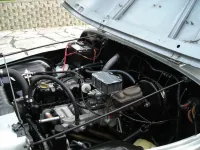
Here is a picture of my 78 CJ7… I did all the work…. Tried to make it look as stock as possible… took me back to the seventies. Here is a pic of the ISSUE with TOO TALL A RADATOR that loop up from the front of engine to the input of the aluminum intake manifold. The air bubble will not want to go down the tube to intake so it acts like a blockage.
This loop works but is too high…. Next updates and electric fan and some other goodies I will be using a the molded hose AMC meant for us to use.
1978 CJ7
Silver paint with black hard top on 33" radials & eagle alumium rims. Good looking ride and have done lots of work to make it look and run great.
Stock equipment is 258 carb, power brakes, power steering, hard top & hard doors (per vehicle gross weight) tilt steering wheel, big brake package with large rotars & drums, T18 Trans with low 6.4 granny gear, Dana 20 transfer, Dana 30 front axle, Dana 44HD rear axle with 3.73 gears. True Trac ft & rear.
I was around jeeps in the 70's and drove a 1973 Jeep Truck. My family had 4 jeeps at the time. We also joined a jeep club back then too. So about 6 years ago looked for a Jeep CJ and found the vehicle above.
I'm actually now planning to run the heater hose through the intake, and I might hook up the electric heater to a toggle switch for cold weather starts.
You have two places in the engine block behind/under the exhaust manifold that would work well for an aftermarket mechanical temp gauge. But that all depends on if you're still using them for their original purpose or not.
The electric intake manifold heater, the porcupine heater, is controled by the thermo switch that is intalled on the manifold already. Electric heaters, this size anyway, consume a lot of energy.... I calc this was like 10 amps so I used a 15 or 20 amp fuse.
The heater is turned on when you turn the key or the use of the oil pressure switch that would activate/switch a control relay to power the heater. I recommend the use of the oil pressure switch so not tooooo.... many amps switched with the ignition switch / key can cause issues or failure. The relay is deactivated with a thermal switch in the jeep alumium manifold. The temp switch is a normal closed switch that opens up like 160F if I remember the temp right. The switch contols GROUND since it attached to manifold/block/grounded........ and supplies the ground to the RELAY. So when the manifold reaches temp.... the temp switch opens up.... breaks ground to the relay.... the relay opens up..... and breaks the +12V to the porcupine manifold heater.
The heater take too much energy for the temp switch to turn off and on. The relay has a coil to change relay open/close and is a low power item. The temp switch can last for every controlling a small coil relay.
I have a good write up on this with pics and all but cannot find.
Use a multi meter on the temp switch to ck for open/closed state. Can test at room them and then immerse in boiling water and the switch will open and close with temp changes. Most Coolant Temp Switches on a used jeep AMC 258 i6 / 4.2l manifold will still work... keep them.
Crysler/Jeep still sells the temp switch and it that write I have the part number.
When I first intalled porcupine heater I used the ignition key and the power to electric choke to power and control the relay along with the manifold temp switch. UPGRADE.... I plan on using the oil pressure switch to control the ON power to the relay.
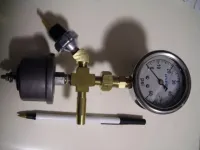
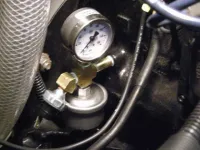
The older 70s jeeps do not have a oil press switch....... This is how I put the oil pres switch, pres gauge, oil pres sender all on one port on my 78 CJ that had a cast iron manifold set.
The other reason I wanted to update to using a oil press switch is the DESIRE FOR A ELECTRIC FUEL PUMP. In a accident or fuel line break type issues if the engine goes off you want the Electric FUEL PUMP to stop and not pump gas all over the hot engine, the ground, etc. So the oil pressure switch can control other control relays.... in my cast a fuel pump control relay.
Fred
Last edited:
Register now
You must register or login to view hidden content on this page.


 (heater hoses and wires to the intake), but would like to get opinions on it.