• Hello Guest, we are proud to now have our Wiki online that is completely compiled and written by our members. Feel free to browse our Jeep-CJ Wiki or click on any orange keyword when looking at posts in the forum.

'81CJ7 Charcoal Canister - ??

'81CJ7 Charcoal Canister - ??

truk820

Jeeper
Posts
216
Media
2
Thanks
1
Location
Chicago
Vehicle(s)
1981 CJ7, Iron Duke 151, SR4 transmission
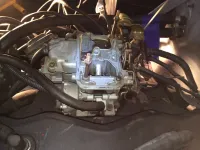
Think it's a Rochester varajet II. Chiltons is showing a Rochester 2se/e2se and a Rochester Yf/YFA. Not sure on the canister.
 
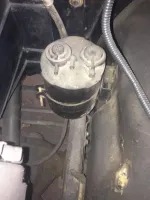
The first pic is a charcoal canister, it's filled with granules of activated charcoal. The purpose is to adsorb fuel vapor from the carb and fuel tank. The canisters from the 70's have 4 outlets, 1-tank, 1-carb, 1 intake vacuum, 1-ported vacuum. The intake vacuum draws fresh air in to purge stored fuel. When the ported vacuum reaches about 12" the secondary purge circuit opens to purge at a higher rate.

You have a newer canister with 3 outlets, my "guess" would be intake vacuum, tank, and carb (facing pic from left to right).
 
Register now
You must register or login to view hidden content on this page.
I pulled the canister and after some scrubbing found the 3 ports are labeled (from L to R) PCV, Fuel Tank, Carb Bowl.

So now I know where they need to go, next step is finding them all. The picture I posted of my carb has 2 lines plugged - is one of those the carb bowl? I'm going to find the numbers on the carb to see if I can find a diagram.

I found the PCV using the Haynes manual but not sure what the fuel vent line should look like. Any diagrams out there to help me out? Total newbie to this. Thanks
 
Last edited:
Just read that removing the charcoal canister, or in my case leaving it disconnected, doesn't affect performance and is only needed to pass emissions. I'm in Illinois and they said any car older than 25yrs is exempt, which means it sounds like I'm good to go in bypassing emissions testing.

Can I just leave this thing as is and not connect it?? Any harm to performance, MPG, etc?
 
A hotly debated issue

Are there problems you are trying to solve, like a fuel smell on a hot day, idle or run issues, or other vacuum related problems?

I wouldn't remove my lines, but if things are running good, I wouldn't mess with it too much either, though I might use caps instead of sheet rock screws.
 
Well I bought it a few weeks ago and it starts but runs rough. No fuel smells (and by the way...noted on the sheet rock screws!) but I'd like to get this guy running properly. If the canister isn't going to affect performance and it's more of a headache than it's worth I'm fine leaving it disconnected before I dive in and try to find everything to connect to.
 
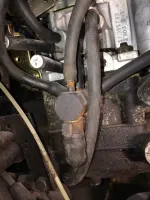
So now I know where they need to go, next step is finding them all. The picture I posted of my carb has 2 lines plugged - is one of those the carb bowl?
No, the bowl vent is above the fuel inlet. You can see a bit of the vent in the first carb pic at the very bottom, looks like there is a hose on it (hard to see).

As mentioned it's a Rochester 2 barrel.
 
If there is no line to the tank that would mean there is an open vent at the tank unless someone capped it already. I would recommend checking the tank vent and cap it if your not going to run a line.
 
No, the bowl vent is above the fuel inlet. You can see a bit of the vent in the first carb pic at the very bottom, looks like there is a hose on it (hard to see).

I took a closer look and there is a hose on the bowl vent with a hose clamp stamp Canada. It's to the right of the stamped #8.

Hope this helps.
 
The PCV line that runs from the carb to the PCV valve is where you put a TEE inline and run the same size rubber hose (gas line will work). Don't splice into the back hose that goes to the air filter assembly, that has no vacuum.

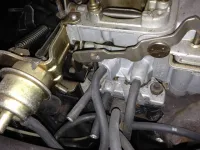
Manifold vacuum (smaller rubber line, 5/32") is on the little manifold vacuum port under the carb. that is on the intake manifold (your second picture). The manifold vacuum draws vacuum whenever the engine is running.

The control vacuum line, 5/32" is either one of the two dry wall plugged ports near the bottom of the carb. just above the manifold vacuum ports. This vacuum source only draws vacuum while the throttle plates are open (driving the vehicle).

The vapor canister is filled with activated charcoal that will neutralize the gas vapors which produce the gas smell that fills the area around your Jeep. (In the garage or just around the Jeep.) Gasoline vapor is heavier that air, so by having the canister mounted low near the frame, the vapors will accumulate in the canister. When hooked up properly, the canister contains the vapor until you start the engine and the vapors are drawn into the engine to be "reburned" again. It's just a environmental "feel/smell good" thing, if it was not connected, it would not effect the performance of the Jeep in any way. Some states have emission testing, and that device must be operational to pass inspection.

The fuel tank vent line is out of the loop of fuel pressure by being hooked to the vacuum canister. Some engines have the fuel vent line hooked to the smaller vent port on the large fuel filter. What happens there, is the fuel pump is powerful enough to push fuel not to only the carb., but back to the tank, creating a circular flow of fuel. This keeps the fuel cooler, preventing vapor lock. If you don't have a vented fuel tank cap, that will put pressure back into the tank. If the canister is hooked up properly, you won't need a fuel filter that sends fuel back to the tank, as that line goes to the canister and the vapor is drawn back into the engine.

Thats what the tree hugging, fish kissers want us to do, so the cows emitting methane gas can fart and we haven't figured out how to put a vapor canister on the cows....... yet.....

:chug:
 
Register now
You must register or login to view hidden content on this page.

Similar threads

  • Question<br> <font color=black> Reply's are voted<br> on for best answer</font> Question
    Reply's are voted
    on for best answer
Replies
6
Views
474
  • Question<br> <font color=black> Reply's are voted<br> on for best answer</font> Question
    Reply's are voted
    on for best answer
Replies
8
Views
340
  • Question<br> <font color=black> Reply's are voted<br> on for best answer</font> Question
    Reply's are voted
    on for best answer
Replies
0
Views
7

Jeep-CJ Donation Drive

Help support Jeep-CJ.com by making a contribution.

Help support Jeep-CJ.com by making a contribution.
Goal
$200.00
Earned
$0.00
This donation drive ends in
0 hours, 0 minutes, 0 seconds
  0.0%
Back
Top Bottom