You must register or login to view hidden content on this page.
So, I have an AMC 304 (1979) so when I got it, it was partially plugged up, de-smogged, etc….
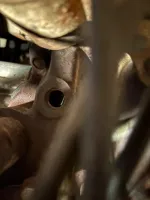
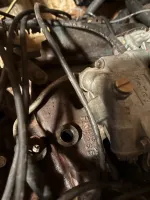
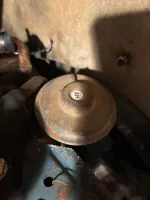
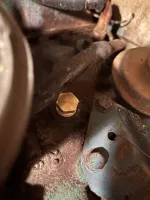
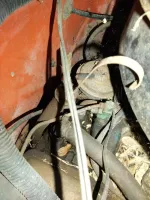
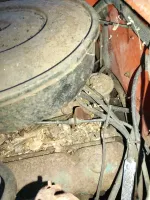
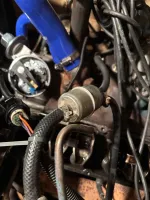
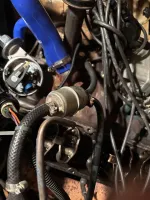
It has 3/8 MIP plugs on 3 places (2 removed currently) on the intake manifold. All 3 of the plugs had vacuum hose nipples (one had 3) on them that were rubber-cap plugged. Then there’s a weird cylindrical apparatus that says “AH”
What should be plugged? Is there a way to find the parts from the original vacuum/distributor “harness” that I’ve heard of? Should I just leave it plugged? I don’t think it’s a California vehicle.
That looks like EGR and other EVAP component locations. I have a 79 AMC 304 at home I'll try to remember to get some pictures of the motor when I get home.
If it's running and you don't need it to pass emissions where you live then I wouldn't worry to much about it
That looks like EGR and other EVAP component locations. I have a 79 304 at home I'll try to remember to get some pictures of the motor when I get home.
If it's running and you don't need it to pass emissions where you live then I wouldn't worry to much about it
Okay, so I got this thing running but it’s running rough. I got my timing light I got marks on the crank, etc.
The problem: when I’m turning the motor by hand, when I reach TDC of the compression stroke, the dist. button is point directly at #1 but if I continue to turn the motor, I find that TDC of the EXHAUST stroke is not 180° from that of the TDC of compression.
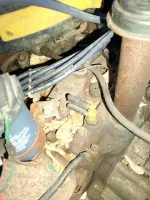
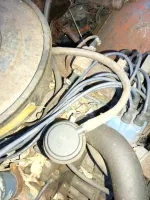
Here’s two pics: the first is TDC of compression, the second is TDC of exhaust… bear in mind that I’m a novice at best with ignition timing.
Should TDC of Exhaust and TDC of intake/compression be 180° apart?
Engines vary wildly. I know the AMC 258 i6 / 4.2l really likes about 9⁰ before TDC the AMC 304 around 10-12⁰ before TDC. So if you're at TDC and right on cylinder 1 then that means your at 0⁰. You need advance your timing. Start by making sure that you have no vacuum leaks. Then start your engine and and rotate the distributor slowly until it idles better.
I tend to do this with the vacuum advance disconnected.
Engines vary wildly. I know the 4.2 really likes about 9⁰ before TDC the 304 around 10-12⁰ before TDC. So if you're at TDC and right on cylinder 1 then that means your at 0⁰. You need advance your timing. Start by making sure that you have no vacuum leaks. Then start your engine and and rotate the distributor slowly until it idles better.
I tend to do this with the vacuum advance disconnected.
To advance the timing on an AMC 304 , you must turn the distributor counter-clockwise. This is because turning the distributor housing in the direction opposite to the rotor's normal rotation advances the spark timing.
1981 CJ5/258 4.2L I6, Tremec T-176 4-speed, Dana 300, Power Steering, Howell Throttle Body Injection System, Warn Locking Hubs, Warn Rock Crawler front/rear bumper with Tire Swing Carrier, Full Roll Cage, Pro Comp ES9000 shocks
On my AMC 258 i6 / 4.2lCJ5 I removed the charcoal canister and circumvented the check and rollover valves with a pair of boat aluminum vents from Amazon.
Don't you get the smell of gas fumes with that solution? I would think just venting fumes from the tank into the air via those vents would create a gas smell, especially if enclosed in a shop or the garage. I'm all for eliminating the smog stuff if you can; but I don't want the gas smell in my shop. I kept the charcoal canister, relocated it, and attached the rollover check valve/vent to the canister, which still has a line back to the throttle body (I have EFI) to suck in those fumes. Here's a short entry about the option I chose: Tank vent option
Okay, so, I’ve recently gone through this AMC 304 after it suddenly wouldn’t crank back around Turkey Day. It turned over, wanted to crank albeit sounded like it was wayyyy too advanced or like it was stumbling over itself — took the timing cover off, checked to make sure it hadn’t “jumped time” and sure enough everything lined up, and the chain deflection looked well within tolerance.
So, I cleaned everything up, new seals/gaskets/cleaned the pan/cover/ rebuilt the oil pump etc. I’m currently putting it all back together.
Simultaneously I’ve been reading everything I can about vacuum/emissions etc. I have a Holley 2BBL 2300 (7448-1) Carb that has 2 vacuum ports (one aft of the carb facing EGR valve & one near the choke mechanism.
I’m a stickler for things being “stock” as I’m sure many of you are. There’s great debate over the effectiveness of all the smog/emission systems these motors came with. Especially if they become clogged or a leak forms.
However, many say that “a properly operating ______ shouldn’t do this …” or “keeps combustion temps down/makes for easier starting and warm up yada yada” … the list goes on.
I feel I could cobble this emission system back together if I really wanted to I either still have or could source the components.
Currently everything is currently plugged/capped minus a vacuum line/port from carb to distributor obviously, and the port/line going from behind the carb a few inches to the intake manifold.
If I were completely rebuilding this motor I’d be more fastidious about sticking with the original setup just for the benefit of getting rid of excess fumes (I would always smell like gas after a quick ride in it) and for cooler operating temps as it is still mostly original.
So, finally, my questions:
1. Is it worth trying to get even some of the emission/vacuum components reinstalled? Say a more traditional 2100 MotorCraft carb and a functional egr valve since the 2100 carb has the proper vacuum ports according to FSManuals.
2. Would an aftermarket intake be the way to go and just “start fresh”?
At the end of the day, I like the idea of a fully-original motor (even though they didn’t produce much power) just to know I’m not running it ragged, but I also don’t wanna waste my time because this thing ain’t gonna be going to a car show anytime soon LOL.
Hi from Colorado. I have a '78 CJ7 that has similar parts disconnected, plugged etc by the PO and mostly by me. The Jeep was/is a high altitude model for CO and has a 2150 carb with an altitude compensator on the back of the carb. (I have pieced this understanding together from Forums, Manuals, Utubers etc and may not be complete or correct!). If you just want to drive it ...and you do not need an emission sticker, why bother with it? If you really want it to be stock let me know since I have the complete Octopus looking mess of tubes, harness, etc that I will never use, also a vacuum pump, bracket, pulley, belt, and some metal tubes still connected to the exhaust manifolds. Further research is a good idea on a 2100 or 2150 vs others. You can get rebuild kits but the basic parts are starting to wear with age so it might depend on where you live, parts available, personal interest etc. Good luck.
Register now
You must register or login to view hidden content on this page.