• Hello Guest, we are proud to now have our Wiki online that is completely compiled and written by our members. Feel free to browse our Jeep-CJ Wiki or click on any orange keyword when looking at posts in the forum.

Engine HEI problems.

Engine HEI problems.

sewrig01

Jeeper
Posts
6
Thanks
3
Location
Louisville, KY
Vehicle(s)
1979 CJ 5. Stock 4.2L, Dana 20
I'm not sure if I messed something up or just have bad luck. I replaced my distributor with an HEI distributor. The jeep will start and idle. However, if I adjust the timing to what should be proper, it has trouble. Once I reattached the vacuum tube it starts racing.

This may be a separate issue, but additionally I have smoke in the engine compartment and the exhaust was red. I don't know if something failed such as my EGR and it's just bad timing or if there's a problem with the HEI install.

At this point I would like any suggestions what to even consider. My Jeep was disabled last Winter when I could have used it in the snow, I don't want that to be the case this Winter
 
What's your timing set to?

Also what engine?
 
Are you able to clearly see the timing mark? Before I replaced my old timing chain, I could never get TDC because the mark would shift or disappear.
 
I feel like I'm on the way to having this sorted. I do have a follow-up question. If anybody cares to chime in. How important is the orientation of the distributor? The new one fits but it does not seem like it can rotate to where it needs to be for timing. Is there any reason that I'm not understanding that we should not adjust it to where the rotor points more outward at top dead center? Also does does it matter which plug on the cap points to one as long as they're in the right order and number one is firing a top dead center? Logically, it seems like that should be the most important thing, but I'm worried that I'm missing some key aspect.
 
  • Thanks for the Post!
Reactions: CJ
If you can't rotate the distributor because of interference you can always pull it, and rotate to another tooth to give you some room.
As for the plug wires on the cap, you are correct. As long as the #1 wire is to the location where the rotor points at #1 TDC the location on the cap doesn't matter as long as the correct wiring order follows in the correct rotation.
 
Ok , so I tried to fix this tonight. I made certain it was TDC of the compression stroke. Positioned the distributor where #1 was pointing to a good location. (able to have room to adjust). I bolted it enough that I could move it, but that it wouldn't slip due to vibration. Then I made certain that the Vac advance was not connected and started it. I managed to get it running at about 900 rpm at 6deg. (this is where it was smooth, but not revving too high. My sticker says 6@700, so I may need to adjust the idle. ) However, as soon as I put the vacuum back on the engine raced. I checked a few more settings, but it always raced when I connected the vacuum advance. The exhaust began to glow red, so I stopped. I am leaning toward believing that I have a defective distributor. (It ran fine with the oem setup and I know that the vacuum is manifold vacuum).

II think that I will try to reconnect the original hardware next, but I welcome any insight.

Thanks for all of the comments and help.
 
Really sounds like your dist is going to full advance as soon as you connect the vacuum. Not good...
I believe you are correct.
Do you have a light with an adjustable advance? Would easily let you know but not really needed. https://www.summitracing.com/parts/sum-g1059
 
Timing is still too much. Have you checked for vacuum leaks?...both in the dist. and everywhere else. Timing and vacuum leaks are the two main reasons for fast idle and lean burning.
 
Agree.
Sounds like a vacuum issue if it changes that much when connecting to distrib.
 
Well, I placed everything back in its original order. Verified that it was at top dead center. Checked and double checked the sparkplug wire placement. And it is behaving exactly the same. Basically I'm able to set it at 2 or so degrees(not more than 4) and it runs around a 900-1000 RPM. If I try to get the RPMs to 700, the timing is well after dead center. It raises to 3, 000 as soon as I plug in the vacuum advance.

It is very frustrating, because it worked before I made the decision to try to put in the HEI distributor.

anyway, I figured I would let anyone who was curious what happened know.
 
I appreciate the update. However if it worked before the upgrade and now back to original it's behaving the same then the issue is not the distributor. It's either A. Something is not set correctly. B. There is an issue somewhere most likely in a vacuum line.

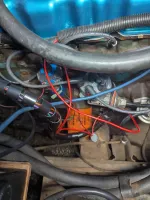
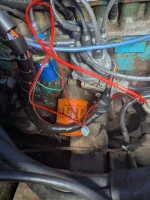
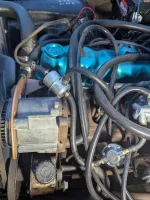
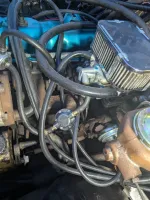
Post some pictures maybe the keen eyes of the group can notice something.
 
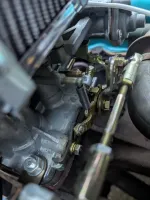
It is running properly. The problem was the carburetor by way of the brake booster. What was happening is that the linkage for the throttle was hanging on the vacuum hose for the brake booster. So every timing operation was as if someone was holding a bit of throttle instead of at idle. Ran it for awhile and took a spin around the clock. No more red exhaust!

Thanks for everyone's help.

PXL_20251218_221625280.MP.webp

PXL_20251218_221630153.MP.webp

PXL_20251218_221641680.MP.webp

PXL_20251218_221643717.MP.webp

PXL_20251218_222113911.MP.webp
 
  • Thanks for the Post!
Reactions: CJ
Time to upgrade that distributor again
 
My Nickel.95

Some distributors are attached to the intake manifold for Full Vacuum. Others require you use a "Ported Vacuum" fitting which is usually on the Carburetor.

See if the HEI requires a "Ported Vacuum" connection...
 
Either full manifold or ported vacuum can be used, depending on the application. For mild street engines with a base timing (no vacuum applied) of 6-10 degrees advanced, ported vacuum should be used. About 98% of the time, a street driven engine is operating at only part throttle. If the engine is properly tuned (carb, clean plugs, good wires, proper A/F ratio), and creating an average 12-16 "Hg, such an engine would struggle and run poorly with additional timing from straight manifold vacuum.

Now engines with idle vacuum levels of 8 or 9 "Hg or below demand more initial timing than milder engines. Choppy idle engines often respond to more initial timing and may react positively to connecting the vacuum advance to straight manifold vacuum. But in most cases these are not stock or "mild" engines. They have more complex modifications that move them away from the average.

Engines intended for competition, such as drag racing, don’t need a vacuum advance system because racers are not concerned with part throttle performance at all.
 

Similar threads

  • Poll<br> Best for votes<br> on specific items Poll
    Best for votes
    on specific items
Replies
8
Views
155
  • Question<br> <font color=black> Reply's are voted<br> on for best answer</font> Question
    Reply's are voted
    on for best answer
Replies
5
Views
357
  • Question<br> <font color=black> Reply's are voted<br> on for best answer</font> Question
    Reply's are voted
    on for best answer
Replies
4
Views
363
  • Question<br> <font color=black> Reply's are voted<br> on for best answer</font> Question
    Reply's are voted
    on for best answer
Replies
12
Views
300

Jeep-CJ Donation Drive

Help support Jeep-CJ.com by making a contribution.

Help support Jeep-CJ.com by making a contribution.
Goal
$200.00
Earned
$100.00
This donation drive ends in
0 hours, 0 minutes, 0 seconds
  50.0%
Back
Top Bottom