
Brakes Questions and Revelations from the Humble Brake Proportioning / Combination Valve '78 CJ-7
iChuck12
Jeeper
- Posts
- 14
- Thanks
- 6
- Location
- Southeast PA
- Vehicle(s)
- '78 CJ-7, 258, TH400, BW 1305 QuadraTrac, AMC 20 Rear, D25 Front Diff(?)
'76 CJ-7 "Levi's Edition", (Still figuring out the specs under all of the rust)
Hello Fellow Greasy-Hand Heroes!
Sorry for the long post, but I have some insights and a few questions about the brake proportioning valve found on many older CJs (my questions at the end...).
I'm in the process of rebuilding the brake system on my '78 CJ7 QuadraTrac , front discs and rear drums, and trying to use as many of the original parts as I safely can. I thought I was all finished and feeling quite proud of myself until I test drove my baby and found that only the front brakes were working (very hot front discs, rear drums cold). It was then that I remembered that I'm not as smart as I'd like to think I am. After a good bit of researching online, I discovered that I knew nothing about securing the proportioning valve before bleeding the brakes...oops. To add to the story, the previous owner said the brakes didn't work right and he couldn't figure it out. That was the reason I decided on a full teardown and rebuild in the first place.
To reset the proportioning valve, I was able to (finally) remove it in one piece, but couldn't get the isolation valve (cylinder in the center of the valve) to move to the center again. After much gnashing of teeth and uttering profanities, I finally decided to jump in and disassemble the whole valve body. Couldn't hurt, it was already "broken". Here it is after a good cleaning.

Tips for others thinking about doing this: After inspection and learning about the movement and action of the valve, I discovered why mine wasn't working/resetting. The Brake Warning Switch (plastic part on the top of the valve body) has a brass/copper pin that extends into the valve body. If there is an upset condition in the braking system (broken brake line, seized caliper, too much air in the line, etc.) the unequal pressure between the front and rear brake lines causes the isolation valve to move from the center and bypass or stop pressure to the part of the system that is not working properly. When this happens, the isolation cylinder comes into contact with the pin in the brake warning switch, completing a circuit that lights up the brake warning light on the dash. (Might be an overly simplistic description, but works for my purposes)
The spring in my brake warning switch (that holds the pin down, but lets it move up if the isolation cylinder moves either way) was made of standard spring steel. At some point in the past, water had gotten into the valve causing the spring to completely rust away into a wet nasty gritty powder. This rust slurry made its way past the brass/copper pin of the brake warning switch and into the area around the isolation valve. From there, the slurry migrated around throughout the proportioning valve and settled in some of the nooks and crannies and partially solidified. This stopped the isolation valve from being able to move either way, leaving my rear brake line bypassed and not pressurizing.
So If you have an original proportioning valve and brake warning switch, its not a bad idea to remove it and check to make sure the spring inside has not started to rust and add rust paste to the rest of the valve body.

Replacing just the switch is not an option since all of the new switches have a different thread size (ask me how I know... glad you asked). After trying out three different switches from three different suppliers, all were way too big. The OEM switch has a 3/8"-24 thread, the new ones are 1/2"-24. So if your switch is toast, you might need to buy a whole new proportioning valve. I'm going to try cutting my switch open, cleaning it out, adding a new stainless steel spring, and gluing or melting it back together. Wish me luck; I'll let you know if that works.
Now for my questions: When I reassemble the entire proportioning valve, the isolation valve does not move easily in the main valve body. I know the o-rings are tight to prevent brake fluid from moving between the front and rear sections of the valve, but how tight should it be? I'm worried that the isolation valve might not move when I need it move. Has anyone tried disassembling one of these before? Can I use something to lube it up, or should the isolation valve be pre-filled with brake fluid before installing the brake warning switch?
Having botched the bleeding of the brakes, is there anything else I should look out for once I have my proportioning valve sorted out?
Thanks for your combined knowledge!
Chuck
Sorry for the long post, but I have some insights and a few questions about the brake proportioning valve found on many older CJs (my questions at the end...).
I'm in the process of rebuilding the brake system on my '78 CJ7 QuadraTrac , front discs and rear drums, and trying to use as many of the original parts as I safely can. I thought I was all finished and feeling quite proud of myself until I test drove my baby and found that only the front brakes were working (very hot front discs, rear drums cold). It was then that I remembered that I'm not as smart as I'd like to think I am. After a good bit of researching online, I discovered that I knew nothing about securing the proportioning valve before bleeding the brakes...oops. To add to the story, the previous owner said the brakes didn't work right and he couldn't figure it out. That was the reason I decided on a full teardown and rebuild in the first place.
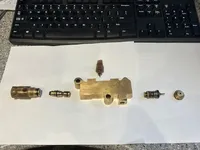
To reset the proportioning valve, I was able to (finally) remove it in one piece, but couldn't get the isolation valve (cylinder in the center of the valve) to move to the center again. After much gnashing of teeth and uttering profanities, I finally decided to jump in and disassemble the whole valve body. Couldn't hurt, it was already "broken". Here it is after a good cleaning.
Tips for others thinking about doing this: After inspection and learning about the movement and action of the valve, I discovered why mine wasn't working/resetting. The Brake Warning Switch (plastic part on the top of the valve body) has a brass/copper pin that extends into the valve body. If there is an upset condition in the braking system (broken brake line, seized caliper, too much air in the line, etc.) the unequal pressure between the front and rear brake lines causes the isolation valve to move from the center and bypass or stop pressure to the part of the system that is not working properly. When this happens, the isolation cylinder comes into contact with the pin in the brake warning switch, completing a circuit that lights up the brake warning light on the dash. (Might be an overly simplistic description, but works for my purposes)
The spring in my brake warning switch (that holds the pin down, but lets it move up if the isolation cylinder moves either way) was made of standard spring steel. At some point in the past, water had gotten into the valve causing the spring to completely rust away into a wet nasty gritty powder. This rust slurry made its way past the brass/copper pin of the brake warning switch and into the area around the isolation valve. From there, the slurry migrated around throughout the proportioning valve and settled in some of the nooks and crannies and partially solidified. This stopped the isolation valve from being able to move either way, leaving my rear brake line bypassed and not pressurizing.
So If you have an original proportioning valve and brake warning switch, its not a bad idea to remove it and check to make sure the spring inside has not started to rust and add rust paste to the rest of the valve body.
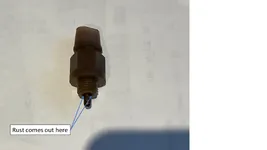
Replacing just the switch is not an option since all of the new switches have a different thread size (ask me how I know... glad you asked). After trying out three different switches from three different suppliers, all were way too big. The OEM switch has a 3/8"-24 thread, the new ones are 1/2"-24. So if your switch is toast, you might need to buy a whole new proportioning valve. I'm going to try cutting my switch open, cleaning it out, adding a new stainless steel spring, and gluing or melting it back together. Wish me luck; I'll let you know if that works.
Now for my questions: When I reassemble the entire proportioning valve, the isolation valve does not move easily in the main valve body. I know the o-rings are tight to prevent brake fluid from moving between the front and rear sections of the valve, but how tight should it be? I'm worried that the isolation valve might not move when I need it move. Has anyone tried disassembling one of these before? Can I use something to lube it up, or should the isolation valve be pre-filled with brake fluid before installing the brake warning switch?
Having botched the bleeding of the brakes, is there anything else I should look out for once I have my proportioning valve sorted out?
Thanks for your combined knowledge!
Chuck
