• Hello Guest, we are proud to now have our Wiki online that is completely compiled and written by our members. Feel free to browse our Jeep-CJ Wiki or click on any orange keyword when looking at posts in the forum.

School Me please - Tuning procedures

School Me please - Tuning procedures

JR74CJ5

Missing-Presumed Wheeling
Lifetime Supporter
Posts
5,829
Media
186
Resources
1
Thanks
74
Location
Plumas Lake, CA, USA
Vehicle(s)
1974 CJ5 ~ Fresh built AMC 360 - SM420 - D20 - D30F with upgraded 30 spline shafts and knuckles & D44R - 4.27 Gears - ARB Lockers F/R - All chrome molly axles - on 33's - YJ 4" Lift Spring Conversion
Register now
You must register or login to view hidden content on this page.
I have always tuned timing per spec, then turned a bit +/- to get the best response and smoothest running symptoms. Then I reset the carb mixture screws to zero, out to recommended spec (I think 3-1/2 out for my MC2100) then increase / decrease the idle speed and mixtures as needed to smooth out...

And called it good from there. I have been unhappy with my tuning by feel / trial and error though... My power top end is lacking when I really get on her, which I understand can be a non tune-able fix (could and probably is internal engine wear). She runs good for what I use her for mostly, but hoping for some improvements...

I've recently read though that the best method of tuning is to use a vacuum gauge and timing light to accomplish a greatly tuned engine...

Please school me on the procedures, etc. I believe it was 007 that had a setting marked on the distributor for elevation and sea level (or close to) locations, a on-board vacuum gauge, and had things spiced up a bit... This got me thinking about how ignorant I am on this subject... I know some, but for the sake of completeness and to ensure what I know is correct, please start from the beginning...

Links to great articles is fine too

FYI - 304v8 - should be stock (Cam and bore etc)
DUI HEI style distributor
MC2100 1.08 Carb with minimal vac hooked up.

I could even have my vacuum lines way out of whack and hooked up wrong...

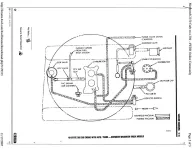
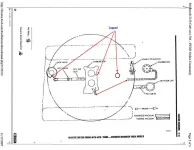
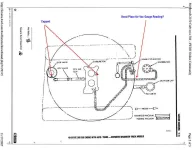
I'll try to get a picture or diagram of my hook up to add here to start with too.

Want a clean running beast for Colorado trail ride appearance this year...

:chug:
 
That looks really close to how mine used to be set up. There are a few missing parts these days. I may have to go seaching :chug:
 
Register now
You must register or login to view hidden content on this page.
Check your PMs


Sent from my iPhone using Tapatalk
 
When was the last time you rebuilt your carb? (sorry if I missed it).

What I do is straight forward.
A fresh rebuild I set the adjustment screws 2 turns out.
A non-rebuilt carb, I turn the screws in and seat both screws easy then back out 2 turns.
Attach a vacuum gauge to manifold full vacuum.
Start a warm engine and note vacuum
Turn both screws a quarter turn in ( keep both screws in the same position, if one is at 12 o'clock so should the other).
Keep adjusting the screws in a quarter turn until you see the vac needle drop a hair.
Back off the screws a quarter turn, and your done.
Take your time between adjustments, and give the adjustment time to work.
If your out 3 turns chances are you have a vacuum leak or carb needs a rebuild.
If possible adjust carb with air filter installed.
This is what works for me.
If you need any assistance with your carb while in Ouray I'd be happy to help.
 
https://youtu.be/UPGLUsW5ZeE
idle mixture screws

https://youtu.be/yPe9OsnLzQ8
curb idle speed

https://youtu.be/UYGU7mTwsZc
setting ignition timing

So, the first 2 videos are for a Holley carb, the basics are the same with the MC2100 carburetor. The third one is pretty generic to any V8 and is from MSD, the guys seem to know what they're talking about.

As far as I've always been taught, and how I do it, always adjust the the timing first, then the carb. Do you have a timing light? Do you have a vacuum gauge? If you don't want to buy them, get them from Autozone, they lend tools for free now. Or you can rent them from O'Reilly's or Advance Auto.
 
Posi - Rebuilt probably a year or two ago - super simple rebuild, but I have bypassed a lot of Vac system. Going to get some pictures or draw up a diagram of mine to see if I'm doing something wrong easy.

Elwood - Thanks bud. I do have a timing light, don't think I have a vac gauge yet, but as much as people are talking about how useful they are, I'll probably buy one soon to have.

I'll check some things out this weekend and get back here to post findings.

:chug:
 
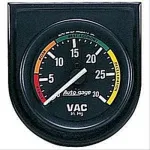
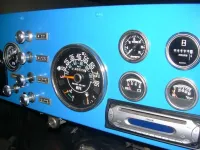
As you mentioned earlier, I put my vacuum gauge on the dash. If you do this, make sure you have a long enough hose on it to move around to what you want to measure (then cap off where it normally stays), then you can put it back where you want to leave it for normal operation.
 
IIRC - my Jeep seems to like ported vacuum at home (400') elevation, but runs way better on manifold vacuum in the mountains. Could be lots of reasons for this, but it's consistently been that way no matter what else has been changed or the reason(s) why.
 
All the older, and newer emission systems were engineered to work together. If you start removing parts it will affect fuel burn. Same goes with the vacuum advance and timing.

That said, if you don't have a complete emissions unit it can be made to work, an adjustable vacuum advance and carb adjustments help. There is some advantages going full vacuum in the right circumstances. Ported advance is just an emission thing.
 
JR, I think you may have chased the rabbit in to the hole, don't go in too far or you'll confuse the **** out of yourself. If you don't speak engineer, don't read the stuff the engineer wrote and try to understand it...

I'm not great with the AMC V8 vacuum and emissions stuff, I'm much better with the AMC 258 i6 / 4.2l . That being said, don't put the vacuum gauge on the distributor vacuum line, that will change with the advance of the distributor, you need to find a place that is just manifold vacuum, I would suggest using the one at the base of the carburetor on the intake manifold.

Speaking of the intake manifold, check to make sure the mating surface is square, I've had an adapter that warped, it looked fine until I put a straight edge on both sides of it (steel ruler) and noticed that it was not in fact straight. Replaced that and it made a world of difference. It would be a little more difficult with the intake manifold, but it if's not straight and you're mounting the carb to it, it's going to leak vacuum, and even a little will make the engine run bad and make you think the carb is junk.
 
Just bought cheapo vac tester for tuning:

https://www.napaonline.com/en/p/BK_7001715?ref=MA==

Now I can install new carb and play with some stuff.

Maybe one day will dash install so I can see what's happening while driving, but for now this will be a good tuning tool.

007 - I may text / call you this weekend - will be playing with the jeep while drinking green beer and eating corned beef all day so we'll see... :booze: :wasted:

:chug:
 

Just went through those videos fully - good info in them all. Like the timing one for explaining a bit more about total timing and curve adjustment. I remember my DUI distributor having curve paperwork inside the box and not knowing what it was.

Also the mixture setting one was great for understanding process of using the vac gauge to set the mixtures.

Thanks buddy

:chug:
 
Ported vacuum is purely an emissions concoction which started back in the late 60s. All it does is prevent a vacuum signal at closed throttle (idle). Without vac advance the engine doesn't run efficiently at idle and generates a lot more heat in the cylinder and right at the exhaust port This helps burn extra hydrocarbons and gets​ the catalyst (if equipped)up to operating temp faster. If you don't need to pass emissions testing there is no reason to use ported vacuum, it will just contribute to sluggish off idle performance​ and contribute significantly to overheating problems at idle.
 
Replaced the carb among other things this weekend.

Tested Manifold vac before the swap at idle warmed up was about 16 - 17

After the swap it started about the same. I think I got it to about 19 and left it there for now. No big needle jumping.

Going to mess with it a bit more, but have to find a new manifold vac connector as I had pulled and plugged the manifold vac port before.

Did a full tune up and fluids change - checked timing (seems to like about 11-12 degrees advance for starts and smooth running).

At this point, she's running great, but I've noticed a gear noise coming from the drivetrain so going to start tracking that down next - hopefully something simple...

:chug:
 
Register now
You must register or login to view hidden content on this page.

Similar threads

  • Question<br> <font color=black> Reply's are voted<br> on for best answer</font> Question
    Reply's are voted
    on for best answer
Replies
8
Views
205
  • Question<br> <font color=black> Reply's are voted<br> on for best answer</font> Question
    Reply's are voted
    on for best answer
Replies
7
Views
35
  • Question<br> <font color=black> Reply's are voted<br> on for best answer</font> Question
    Reply's are voted
    on for best answer
Replies
10
Views
1,043

Jeep-CJ Donation Drive

Help support Jeep-CJ.com by making a contribution.

Help support Jeep-CJ.com by making a contribution.
Goal
$200.00
Earned
$0.00
This donation drive ends in
0 hours, 0 minutes, 0 seconds
  0.0%
Back
Top Bottom