1979 Jeep CJ5 with 304 V8, T18 Transmission, Dana 20 Transfer case with TeraLow 3:1 gears, 4.88 axle gears, Detroit Locker up front and Ox Locker in back with 1 piece axle shafts, 36" SuperSwamper SX Tires, Shackle reversal, MileMarker Hydraulic winch, MSD 6A ignition.
i would love to do this to my jeep, except i cant afford the msd 6. if i go with the streetfire will it wire up the same as in the diagram and would i need the same extra harness?
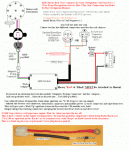
Yes, if you get the StreetFire ignition you can still get the same MSD harness PN# 8869 to tie into your magnetic pickup. Or you can just splice the wires (this is also true if you get the 6A ignition).
Here is the MSD wire diagram:
got my streetfire cdi today i installed it and it does make a difference. i havent started the jeep in a while so i had to get the gas going and it cranked for a bit but it does idle better. and now all i have left is to tie up the wiring.
You must register or login to view hidden content on this page.
I'm a new poster. About 35 years ago I had a 76 model CJ5 and was thinking of finding an older CJ7 . Does anyone know when the CJs began using electronic chips/cards in their vehicles??
1. Copper Based 'Never-Seize' or a like product on the spark plug threads.
This keeps your cast iron threads in the head from rusting,
And it promotes electrical contact between spark plug body and head.
2. If it's a V-8, run a dedicated 'Ground' wire between heads.
Most V-8 engines have one well 'Grounded' head, the other... Not so much.
I run mine in the back were the wire isn't seen. 12 Ga. is plenty.
3. Spark Plug Gap should be kept around 0.045" for most stock engines.
Opening up the plug gap drives firing voltages to the moon,
When you make a ton of voltage, it reduces the Amperage or 'Heat' in the spark discharge.
Larger gaps on 'Exotic' fuel engines is sometimes a requirement,
But with these over rich gasoline engines we run, 0.045" is plenty, and still allows for a good Amperage hit at the plug gap.
You will also find your rotor terminals, cap terminals and plugs last a lot longer with a reasonable gap.
4. DO NOT bundle your plug wires!
Keep at least 1/2" between wire with wiring looms,
3/4" to 1" would be better.
5. DO NOT drape your plug wires over metal!
When a plug wire comes into contact with metal, an electrical process happens that SERIOUSLY reduces your spark energy to the plugs happens.
I'm a new poster. About 35 years ago I had a 76 model CJ5 and was thinking of finding an older CJ7. Does anyone know when the CJs began using electronic chips/cards in their vehicles??
once this up grade is done, should the timing be adjusted? i just put in the streetfire i have my plugs gapped to .045 and my timing is about 8-10 degrees. i set it to the info i found for my engine year.
once this up grade is done, should the timing be adjusted? i just put in the streetfire i have my plugs gapped to .045 and my timing is about 8-10 degrees. i set it to the info i found for my engine year.
Once you take the 'Start' or 'Cranking' circuit out by installing an aftermarket module,
It's a REAL good idea to leave your Initial timing around 6° or 8° degrees Before TDC.
MSD is a DIRECT fire ignition (Like HEI and most other direct fire modules) and there is no provision for 'Start' or 'Cranking' of an excessively cold or hot engine.
With an Initial Advance of 6° to 8° degrees, you will still have reasonable starting without firing the cylinder too soon with a REALLY SLOW crank speed.
-------------------------
If you want to bump up advance a little sooner (Springs) or a little higher total to make up for what you don't get on Initial, that's VERY easy to do with the factory Jeep/Motorcraft distributor since it's made with advance built in,
And both the Vacuum Advance & Centrifugal Advance are adjustable without removing the distributor from the engine.
The lower Initial advance will make for MUCH easier starts when the engine is either very cold or very hot,
And the DuraSpark module had a 'Start' or 'Crank' circuit built in ('White' Wire) that knocked timing back between 8° and 10° crankshaft degrees when activated during start up.
-----------------------
0.040" to 0.045" gap is about perfect for a street driven engine.
We don't have coil on plug, so we can't fire 'Platinum' plugs,
We don't have spark duration the coil on plug systems do,
So keeping the plug gap reasonable will give you better spark energy at the plug,
While still allowing the ignition coil to saturate for the next firing cycle.
If you jack the plug opening open too far, you waste a TON of time waiting for the coil to produce VOLTAGE to ionize that plug gap,
And that cuts way back on the time the spark actually appears in the plug gap,
Kills Amperage and Duration of the actual spark in the gap.
Wasting time is never good when we are talking the short duration you have to effectively get the cylinder lit and have it do any good...
Multi-sparks at lower RPM helps, but it's all about time, and we are talking REALLY short times, around 3/1,000 of a second window at 2,000 RPM to get the fire lit,
So it's pretty important NOT to delay the spark energy pulse by building up a ton of voltage.
With a bigger cap and wires you can gap your plugs at 0.45" to 0.50"
When you install the MDS ignition module you can gap your plugs at 0.50" to 0.60"
OEM was 0.35"
I've eliminated the factory brain, using the MSD 6A ignition
Lighter springs via the recommended kit 925D
MSD adapter and large cap 8414
MSD wires 5551
I ended up using the 646 gapped large to .50 to .55
Should I decrease the gap? Thoughts?
I still have a full 3 - 5 seconds of cranking before my 360 fires up. Could the excessive gap alone cause that issue?
1979 Jeep CJ5 with 304 V8, T18 Transmission, Dana 20 Transfer case with TeraLow 3:1 gears, 4.88 axle gears, Detroit Locker up front and Ox Locker in back with 1 piece axle shafts, 36" SuperSwamper SX Tires, Shackle reversal, MileMarker Hydraulic winch, MSD 6A ignition.
I saw your question but was waiting for TeamRush to answer. I know he prefers a narrower gap than what I recommended. I got my values from MSD.
Here is what MSD says: http://www.msdignition.com/uploadedFiles/MSDIgnitioncom/Products/Ignitions/6420_instructions.pdf
On page 3 of that PDF they say for compression up to 10.5 to 1 start out with a gap of 0.50" to 0.60"
Compression of 10.5:1 up to 13:1 use a gap of 0.40" to 0.50"
And for higher compression than that narrow the gap down more.
But those are just starting points. Here's what MSD says:
Spark Plugs: Choosing the correct spark plug design and heat range is important when trying to get the best performance possible. Since there are so many engine combinations and manufacturers, MSD does not recommend which plug or gap is exactly right for your application. It is recommended to follow the engine builder or manufacturer's specification for spark plugs. With that, you can then experiment with the plug gap to obtain the best performance. The gap of the plugs can be opened in 0.005" increments, then tested until the best performance is obtained. MSD judges the plug gap by compression and components:
1978 CJ7
Silver paint with black hard top on 33" radials & eagle alumium rims. Good looking ride and have done lots of work to make it look and run great.
Stock equipment is 258 carb, power brakes, power steering, hard top & hard doors (per vehicle gross weight) tilt steering wheel, big brake package with large rotars & drums, T18 Trans with low 6.4 granny gear, Dana 20 transfer, Dana 30 front axle, Dana 44HD rear axle with 3.73 gears. True Trac ft & rear.
I was around jeeps in the 70's and drove a 1973 Jeep Truck. My family had 4 jeeps at the time. We also joined a jeep club back then too. So about 6 years ago looked for a Jeep CJ and found the vehicle above.
I saw your question but was waiting for TeamRush to answer. I know he prefers a narrower gap than what I recommended. I got my values from MSD.
Here is what MSD says: http://www.msdignition.com/uploadedFiles/MSDIgnitioncom/Products/Ignitions/6420_instructions.pdf
On page 3 of that PDF they say for compression up to 10.5 to 1 start out with a gap of 0.50" to 0.60"
Compression of 10.5:1 up to 13:1 use a gap of 0.40" to 0.50"
And for higher compression than that narrow the gap down more.
But those are just starting points. Here's what MSD says:
Like I said TeamRush prefers a narrower gap so I'd like to see what he says.
I have also posted a few times about the need for smaller gaps in our AMC engines.... ONLY go to the larger spark plug gap of .040-.045" if you have the TEAMRUSH tune up parts and aux grounds..... if not stay with the .035" plug gap using stock copper AUTOLITE spark plugs..... Your ignition parts will last longer, normal life, and your ignition will work and work right... Learn how to read your spark plugs and use the NORMAL stock heat range plugs.... Get your igntion healthy, carb adjusted, and read your plugs... they should be tan....
Once you have this..... look at your spark plug ground stap..... there will be a color change half way up/down the strap.... usually adjusted with the time or AF/carb.... I have found tooo much advance and the cylinder gets hot and often comes with too much fuel since trying to burn the extra fuel needs more time.... NO STAP COLOR and usuall tooo much time, lots of initial, and adjusted wrong or "not corrected"... Computer X users need to fix their advance curve, take out all the inititial advance and get this so it works right again... will mention this below in more detail
I agree with TeamRush that the spark plug gap is often opened up toooooo far and not necessary... I have posted several times since I joined Jeep-CJ.com that once the TeamRush larger tune up parts are used the spark plug gap can be opened to .040 to .045" from the stock recommendation of .035". The only reason we can open the gap a little bit is the LARGER Diameter Cap and TALLER Rotar with PREMIUM Spark Plug Wires will get the high voltage spark plug energy toooooo the spark plug gap.... With out cross fires in the smaller cap, or spark jumping to ground in the cap via the metal parts and ground path in the distributor (So common on HEI distributors after yr or few months of use get the red dust), or even the High Voltage energy jumping from the wires to the engine ground or any metal contact..... even spark plug wires that touch or are too close or tooo parallel to each other...
The IGNITION is a inductive, resistive, capacitive circuit and could be called a IRC circuit. The spark plug gap becomes a capacitor..... the larger the gap the bigger the capacitory value. HIGHER VOLTAGE is needed to jump the larger spark plug gap..... so a larger capacitor with larger gaps and not linear voltage goes up quick..... Further, larger spark plug gaps SLOW DOWN the ignition circuit TIME..... because it takes more time to build up the higher voltage. The higher voltage is also hard on the other part in the ignition. Higher voltage also jumps the gap quicker at higher voltage..... like static discharge on carpet is also 20k to 40k volts.... Lower voltage will discharge across the spark plug gap for longer time.... amperage. Longer spark time.
Spark plug wires will not last as long and tune parts with higher voltage.... kinda like hitting them with a min welder rew times a second.... if VOLTAGE jumps to easiest ground via a plug mount or engine metal ground the spark plug wire can ground out and will fail pretty quick.... I had one fail with .045 gap in less than two years..... Also notice MSD said you need to run 8.5m Spark plug wires like theirs or theirs and IS >>>>> VERY IMPORTANT..... TeamRush has tested lots of wires and the only ones he likes are the premium MSD wires and even the parts stores Street Fire versions did not pass testing... how many jeeps CJ run MSD wires... $75 wires.... there is resistance buying $7 adapter so TEAMRUSH tune up parts can be used
Further many do not use the MSD ignition modual
DuraSpark Modual..... the more time the stock modual is ON and getting ready to fire the hotter the modual electronics get.... Use .060" or more and the VOLTAGE gets up there pretty quick, the ON time increases and you are going to over heat and fail your DuraSpark..... The CHEAP Clones of the MotorCraft Duraspark Ignition Moduals will die from excessive heat much much much quicker. USE large plug gaps with the CLONE durasparks modual types and you will be walking once the summer temps come.....
When I reading the MSD Instructions.... did you catch they say distributor fire signal wires need to be protected from noise... use the metal ground plane, twist the wires to min cross talk and induced currents... I would twist at 2-3 turns per inch, MSD missed that part of recomendation, how much to twist...
Kill a DuraSpark modual and the replacements are much weaker..
Large plug gaps will over heat modual. Poor gound in, poor head gound, leave ignition on with out engine runnning will alll kill the duraspark in short order...
WE are trying to get the spark energy to the spark plug gap....... the spark plug gap wants to jump to any ground location that is easier to jump to than the spark plug gap..... it is like flowing water ... it will flow to the least resistance and easiest path.... in any part of the ignition.... Big Gaps will drive up the heat in coil, heat up formvar insulation, and can cause shorts and early failures in the coil too....
NET NET.... with large spark plug gaps going above the .040 to .045" with the stock AutoLite Copper plugs will just wear out your tune up parts..... cap,rotar, wires, spark plugs, coil and DuraSpark Modual quicker than it should.... will cause more failures and will not make the 100 hp I6/AMC 258 i6 / 4.2l or the 130HP AMC 304 /V8 run any better, worse actually in short order if read this with understanding.
MUCH more success for our 35 year of Jeep CJs can be had by the study of the computer controlled Jeeps that are newer than the 1981 or 81 (cali). Once we take the computer out, or sometimes called NUTTERED, and happens if ignition sensors not working right...... engine would be in LIMP HOME MODE the IGNTION CURVE is not right and needs to be adjusted.... the stock distributor can be recurved easily and is completely adjustable..... the proper advance curve is listed in the Jeep FSM, Field Service Manual for the non computer years and 1978, 1979 , 1980 are perfect years to look at. Engine size, vehicle weight, Transmission type, vehicle under load/ lugged often/ pull trailer will have different advance curves.... Learn how to do this and your engine will wake up big time....
Note ..... this is why HEI gets used so much, and talked up too much in my opion.... BUT the HEI clones for the AMC have toooo much advance.... lots of knock issues, should be recurved and tested completely for AMC, and there are gear issues, and there are physical fitment issues too, too long, gear not in right spot, some even bind the oil pump up.... Duraspark is easier to adjust so might as well fix what you have the stock stuff....
TeamRush is tune up parts...... larger cap, taller rotar, premium spark plug wires..... then let it work and get spark energy out to the plugs and back to the battery.... This means aux ground all over the jeep duraspark modual, the head (s), the spark plug threads using copper antiseize, and routing wires so they do not touch each other, run parrallel, or touch engine or metal that is grounded.... simple engine that can be tweeked to run pretty well.... even your alternator needs aux ground
CJ 258 with normal tires, healthy engine can get 20 mpg++++ on the hwy, 3500-4500 rpms pretty easy, and go down the road at 65 mph.... TeamRush added 20% pep, better starts, 1000 rpm range, to my new long block build..... My comparison with brand new tune up parts.... I can rev to 4500 rpms when shifting pretty easy and cruise down the highway at 65-70 for hours.... I get 23 mpg hwy doing 55/60 and used a vaccum gauge and maxed the reading to learn how to stay out of gas pedal and max the vac levels...
YES...tune up stock parts or better TEAMRUSH tune up parts.... will need to adjust the time and the carb settings.... YOU have change the electrical time of circuit and the better ignition needs to have all parts adjusted to take advantage of the TUNE UP>>>>
Will need to adj the time and then carb.... go back and adj the carb, and then do the time again..... This would include recurve your 1982 or newer AMC DuraSpark Distributor advance curve if want to run well...... FAR FAR FAR too man helpers are recommending 10-12 or more initial advance settings and that is why there are hard starts..... that is a lot of advance and when slow cranking to start motor that can cause lots of cranking........ problem so big with HEI Dissy in AMC that not too un common to have ignition OFF switch so not spark till cranking than allow ignition ON to allow spark after cranking...... Band AID for HEI Dissy so fix up your duraspark stuff and boy can you be a happy camper.... I had a guy travel 10 hrs one way to have me fix his ignition.... Learn how to do this and you will be the best bud in your local jeep club.
The DuraSpark has two spark circuits.... the start & run.... the start when cranking retards the time 8 deg or so for easy starts and min the chance of damaging the engine and get easier starts.... nice very nice benefit of stock ignition.
At min I would also suggest you test your stock style coil....
the resistance measurements are in your FSM and give you good indication if there are faults or short internal to coil.... When you take plug wires off while running or drive voltages tooo high.... the coil will get small voltage jumps in the coil windings.... there are two windings, one big winding set and one small winding set.... This is thin wire with a shelack coating they call formvar.... Voltage jumps cause HEAT in coil and the forvar melts and you get SHORTs since the copper wire is now touching... and coil will not get the right voltage out..... failed coil and you are walking home...
WE can all agree the stock recommendation for spark plug gap is .035"..... if we go to .060 or keep going as the MSD said to do.... we will nearly be 2x the stock recommendations..... not necessary... and your duraspark modual will not last long... Also adding lots of heat energy to the spark plug and not sure how that will affect the reading of plugs and the location of the spark plug ground strap color reading..... my gues plug gets so hot it will drive the color change off the end of stap and no color change..... guess on my part.... and intersting test if you want to play some....
TeamRush has some pretty good ideas.. and good teacher....
me... eng with mech, electrial, physics education and 30 years in electronics.... his stuff is pretty goood!
"MUCH more success for our 35 year of Jeep CJs can be had by the study of the computer controlled Jeeps that are newer than the 1981 or 81 (cali)."
MN CJ7 - I believe the above statement should say newer than 1982 or 81 in Cali. Meaning any 83 model or newer (82 or newer in Cali.) has one.
My understanding is the computers started being put in the 83 models. My 82 does not have a computer, just the idle control module on the pass. side fender, which was kind of like the predecessor to the full blown underdash computer.
Also, I haven't gone back and read thru all the pages, but what do you recommend for and ignition coil upgrade to go with the teamrush upgrades on a stock dizzy, no computer, de-smog'd component, AMC 258 i6 / 4.2l engine?
1978 CJ7
Silver paint with black hard top on 33" radials & eagle alumium rims. Good looking ride and have done lots of work to make it look and run great.
Stock equipment is 258 carb, power brakes, power steering, hard top & hard doors (per vehicle gross weight) tilt steering wheel, big brake package with large rotars & drums, T18 Trans with low 6.4 granny gear, Dana 20 transfer, Dana 30 front axle, Dana 44HD rear axle with 3.73 gears. True Trac ft & rear.
I was around jeeps in the 70's and drove a 1973 Jeep Truck. My family had 4 jeeps at the time. We also joined a jeep club back then too. So about 6 years ago looked for a Jeep CJ and found the vehicle above.
"MUCH more success for our 35 year of Jeep CJs can be had by the study of the computer controlled Jeeps that are newer than the 1981 or 81 (cali)."
MN CJ7 - I believe the above statement should say newer than 1982 or 81 in Cali. Meaning any 83 model or newer (82 or newer in Cali.) has one.
My understanding is the computers started being put in the 83 models. My 82 does not have a computer, just the idle control module on the pass. side fender, which was kind of like the predecessor to the full blown underdash computer.
Also, I haven't gone back and read thru all the pages, but what do you recommend for and ignition coil upgrade to go with the teamrush upgrades on a stock dizzy, no computer, de-smog'd component, 258 engine?
Thanks for your note and reading with detail.... I typed that on the fly from memory.... I like the TEAMRUSH and what it can do for our 35 yr old jeeps.... I am running the CDI Ignition with TEAMRUSH & lots of AUX Grounds and would like to make one more comment about the affordability and one more big benefit... MY CDI/MSD ignition is a trail back up to my orginal 1978 DuraSpark Ignition Modual ( change dist connector, change coil connector, add/remove aux ground into duraspark m) ....AND....can switch back and forth.... Trail Back up. Along with that idea.... if If every sell my CJ keep the CDI/MSD and hook up the DuraSpark that has worked for 35 yrs on my rig. Use the MSD on the next CJ. That means you only have to buy one MSD ever...
I also wrote...about tune up, and saw typo
The second round to adj the carb/time.... was switched the second time by mistake..... So on second round note that time is close, very close, adj your carb settings.... Then go back and do a final set on the time.... Never just say set at 4 initial adv and leave it... Need to test at 1 deg intervals and see what works best for pep and does not give hard starts or any pingining... Then ck your plugs and plug ground strap... Write your results down in a notebook
Questions...
1981 was the last year BBD Carb was a non feedback unit.... California started in 1981 with feedback carb and some control.... I often say want a nice BBD NON Feedback to rebuild and I shoot for the 1981 and have one on my shelf. That carb is a advance in design and no feedback pins. NOT 100% Positive the year the computer started but I usually say 1982 for most of USA and 1981 in California... After this many years and owners most new owners will have to look to see what is there.... You read with detail and thanks for following around... So I said "NEWER" than 1981, the next mfg year is 1982, and the exception would be 1981 Calif because they started with feedback carb in 1981. Pretty sure the feedback carb dates I am using are correct..... not 100% computer use is the same date .... and will look at some notes I have.... but good question and thought.
Nutter.... also sets the feedback pins on BBD to a set location.
COIL...
I understand the TEAMRUSH stuff but JeepHammer is the author, I am a student... For our CJs he recommends the oil filled coils and the Ford E Coil..
If you use the stock DuraSpark Igntion on the I6 and 4 banger, TeamRush, Aux Grounding use the oil filled coils on the AMC 258 i6 / 4.2l ....
If you use the stock DuraSpark Igntion on the v8,runs higher rpms, TeamRush, Aux Grounding use Ford E coil on AMC 304 , 360....
CDI use or plan to use use the Ford E Coil on both I6 & V8
With your stock DuraSpark Ignition Modual & stock oil filled vertical coil, can use the stock horse shoe connector & stock coil mount.... so its easy to do.... and works..... When doing coil/ignition work clean stuff up and improve reliabilty, remove contacts clean them, make sure the wire termination is sound, if not reterminate it, solder, clean, cover with heat shrink (also strain relief). ON the V8s... they have higher rpms and the Ford E Coil will give you better results with the higher rpm operation range....... so will need a connector change to run Ford E Coil. This will require a new connector for E coil and it will require a physical mount to the engine, and it uses a different TYPE of spark plug mount..... E Core uses a male stud comming out the top like the rest of the TEAMRUSH PLug Wire Ends.
Run a CDI or plan on running CDI/MSD very shortly then go with the Ford DuraSpark its a good combo. I have several E coils from u pull junk yard, take the connectors, wires, extra conn if i see them, take the physical mounts too for mods to plates I use for mounts... Then all the spark plug wire ends match.....
So a simple question .....your question....... what coil to run....
What coil to use has a few considerations?????... I hope that helps a bit more.... What coil type, oil filled / Ford E, you use can affect your spark plug wires, coil connector from Igntion Modual/ or MSD/CDI, the mount to engine can change. I like the Ford E Coil use unless you run the stock DuraSpark Ignition Modual on the 258/AMC 232 i6 I6 or 4 banger then use the stock oil filled coil type........ that one will have different type of spark plug wire ends.... so you will need two types of short spark plug wires for your trail spares...
I CAN SEE THE NEXT question, the MSD make your own two coil wires may need to be made, M/F & F/F. JeepHammer does not like me to say it but I have had good luck with the Napa Dark Blue Belden Spark PLug Wires for TeamRush, they have both type of coil combos, F/F & M/F in the box, and lifetime warranty. They will fail in few years but I took the failed plug wire to counter with my multi meter and walked out with a new plug wire set. I want the MSD premium plug wires....... if you have coin get them...
Here is a TEAMRUSH drawing below with more detail, part numbers for the coil connectors are there is you need new ones.... I collect used ones when I see them.... If you want the stock duraspark/teamrush/258 stay with stock coil and measure your coil resitance per FSM to see if it needs to be replaced. Ck and clean all your electrical connections, mate / unmate 8/9 times or so after cleaning so contacts wipe clean, then add dielectric grease to both halves and mate for last time.... Will stay clean and no moisture to corrode further...
I was waiting for TeamRush but his computer went down.... Glad I could help...
I did the TeamRush mod (minus the MSD module) about 1000 miles ago. Ran great until this morning. I was sitting idling and it just quit. It is getting gas, no spark. I put a new ignition module in, but still no start. I'm thinking it might be the distributor cap and rotor. My question is--what is a reasonable life expectancy on the cap and rotor? I got the good Napa ones.
Thanks
Scott
1979 Jeep CJ5 with 304 V8, T18 Transmission, Dana 20 Transfer case with TeraLow 3:1 gears, 4.88 axle gears, Detroit Locker up front and Ox Locker in back with 1 piece axle shafts, 36" SuperSwamper SX Tires, Shackle reversal, MileMarker Hydraulic winch, MSD 6A ignition.
I did the TeamRush mod (minus the MSD module) about 1000 miles ago. Ran great until this morning. I was sitting idling and it just quit. It is getting gas, no spark. I put a new ignition module in, but still no start. I'm thinking it might be the distributor cap and rotor. My question is--what is a reasonable life expectancy on the cap and rotor? I got the good Napa ones.
Thanks
Scott
Without replacing the ignition module troubleshooting is the same as a stock ignition. Yes the parts are different but the voltages should be the same. That's where we need to start. What are the voltages on the coil? When the key is turned to run (no need to try start) you should have 12v on +.
A bad distributor cap or rotor will not cause it to die so suddenly. It would usually cause the engine to run rough.
I went ahead and replaced the distributor cap, rotor, and the coil. I figured if none of them fix the problem, at least I would have trail spares. After I changed the coil, I would get a momentary spark right when I let the key go from start to run. No other spark than that. I also got a whoosh noise and some smoke out of the carb on my last attempt. I haven't measured volts at the coil yet. I measured the primary and secondary resistance on the coil. They appeared to be within the tolerances listed in the Chilton manual. I don't recall seeing anything about measuring volts across there. Where exactly do I measure the 12V? On second reading, I see you said on the positive terminal. I'll try it first thing tomorrow.
Thanks
Scott
With the key in the run position, I'm getting 4.8 volts at the + terminal of the coil. Battery is showing 12.2 volts on my multimeter. So I guess I am not getting enough volts to the coil. Ideas?
Thanks Scott
Register now
You must register or login to view hidden content on this page.